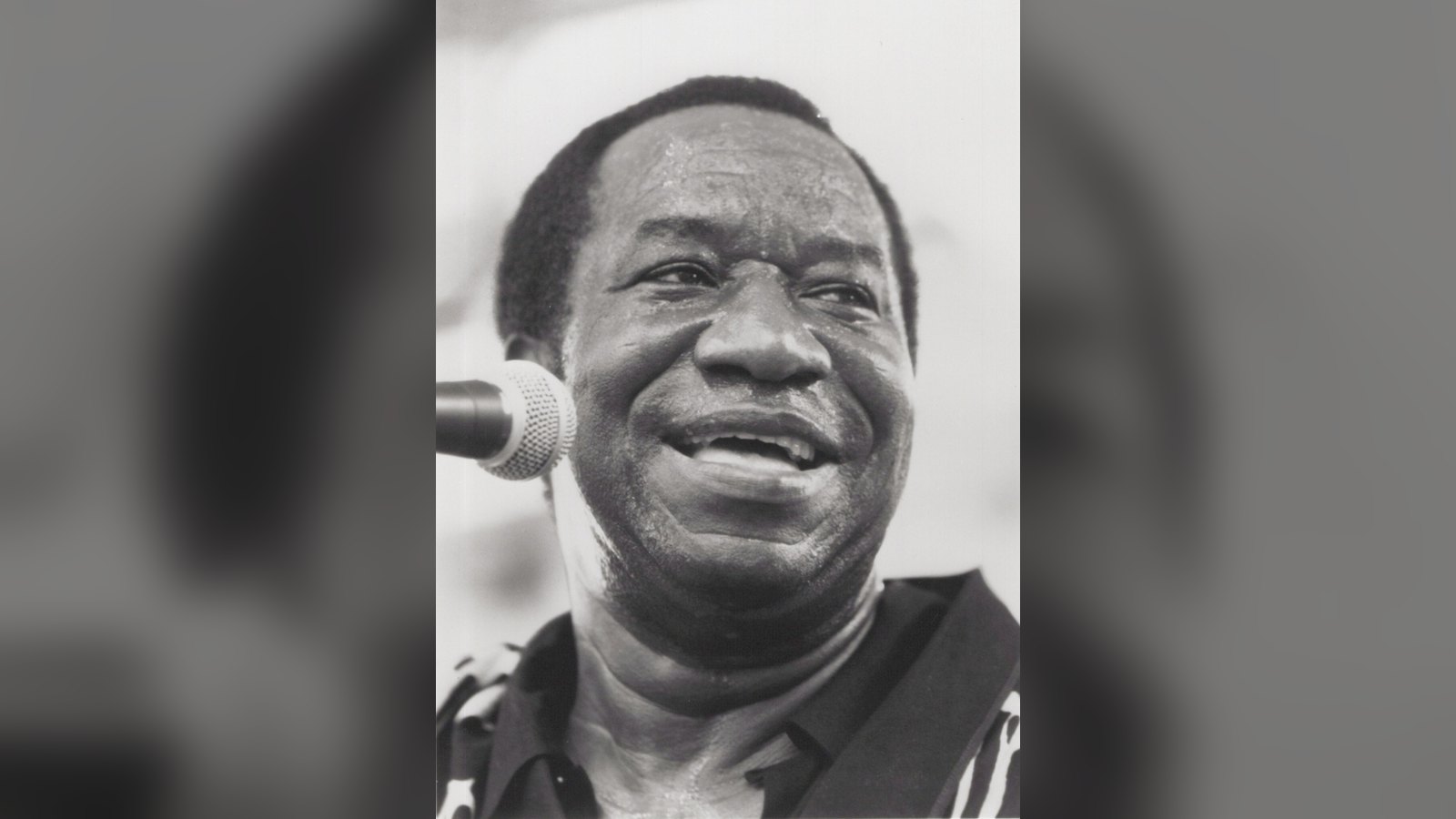
Tabu Ley Rochereau was the Congolese singer, songwriter and bandleader who helped turn rumba into Africa’s most influential pop sound between the 1960s and 1980s. His clarion, honeyed baritone, his bands African Fiesta and Afrisa International, and his landmark 1970 concert at the Paris Olympia made him a giant of the golden age. If you searched “tabuley” as one word, this is the same artist.
Who Tabu Ley Was
He was born Pascal-Emmanuel Sinamoyi Tabu. Most sources give 1940 as his birth year, and some give 1937. As a schoolboy in Léopoldville (now Kinshasa), he earned the nickname Rochereau. He used it for decades until Mobutu’s authenticité campaign pushed Zairians to drop European names. He then became Tabu Ley, and fans added the honorific Seigneur.
Myth
Many listeners assume Rochereau was a family name. It was a school nickname taken from Pierre Denfert-Rochereau, a French colonel who led the defence of Belfort in 1870–71. It had nothing to do with his ancestry.
Career Timeline
- 1959: Joins Joseph “Grand Kallé” Kabasele’s African Jazz, the band behind “Indépendance Cha Cha.” This was his apprenticeship.
- 1963: Leaves with guitarist Docteur Nico (Nicolas Kasanda) to form African Fiesta. Their partnership produced some of the era’s most liked records.
- Mid-1960s: The pair split. Nico runs African Fiesta Sukisa, and Rochereau leads African Fiesta National.
- 1970: In December, he plays the Paris Olympia, becoming the first sub-Saharan African artist to perform there and the second African artist overall, after Egyptian singer Umm Kulthum. The same year, his band becomes Afrisa International.
- Early 1970s: He adopts the name Tabu Ley under authenticité.
- Early 1980s: Mbilia Bel joins Afrisa. Their duets become a second golden run.
- Late 1980s: He goes into exile abroad as political pressure in Zaire grows.
- 1997: He returns after Mobutu’s fall and serves in Laurent-Désiré Kabila’s government.
- 2013: He dies in Brussels on 30 November after years of ill health following a stroke.
Why His Music Still Matters
I hear three things that set Tabu Ley apart from his peers.
The first is the voice. Franco’s TPOK Jazz had grit and swagger. Rochereau sang with a lightness that made even sad songs float.
The second is staging. He brought a drum kit and dancers into rumba shows built for theatres, and the Olympia date proved Congolese music could sell to an international audience on its own terms.
The third is talent spotting. Sam Mangwana sang with him early on, and Mbilia Bel became a star through Afrisa. Guitarists like Michelino Mavatiku shaped the band’s sound.
The rhythmic DNA of that era runs straight into modern West African pop. Our explainer on what Afrobeats music is and where it came from covers that lineage in more detail.
Best Songs to Start With
- “Mokolo Nakokufa”: The title means roughly “the day I die.” He imagines how different people will react to his death, and it is witty and morbid at once.
- “Pitié”: A pleading love song that shows off his tenor.
- “Muzina”: One of his signature tracks and a staple of his compilations.
- “Kaful Mayay”: A gorgeous, slow-building Afrisa recording.
- “Nakei Nairobi”: A duet with Mbilia Bel that nods to his huge East African following.
- “Sorozo”: Pure dance-floor rumba with a long guitar section.
Essential Albums
| Album | Label | Why it matters |
|---|---|---|
| The Voice of Lightness (Vol. 1 and 2) | Sterns Africa | The best consolidated overview of his 1960s and 1970s peak |
| Babeti Soukous | Real World (1989) | A live-in-studio set aimed at world music listeners |
These compilations are the easiest way to hear the early catalogue. The original singles were scattered across many labels and are hard to find on vinyl.
Milestones and Honours
| Year | Milestone |
|---|---|
| 1970 | Headlines the Paris Olympia |
| 1997 | Appointed to Congo’s government after returning from exile |
| 2021 | UNESCO inscribes Congolese rumba as intangible cultural heritage |
The 2021 UNESCO listing recognised the genre as a whole rather than him personally. Still, I can’t think of anyone whose passion did more to earn it. Obituaries credit him with writing songs numbering in the thousands, though no exact count has ever been verified.
Listen next
Put on Franco and TPOK Jazz’s “Mario” to hear the rival school of golden-age rumba.
Similar Artists
If Tabu Ley clicks for you, try these next:
- Franco Luambo Makiadi: His great rival.
- Docteur Nico: His former partner, known for brilliant guitar work.
- Grand Kallé: The bandleader who gave him his start.
- Sam Mangwana and Mbilia Bel: Two singers who came up through his bands.
- Papa Wemba: A star of the next generation, through Zaïko Langa Langa and Viva La Musica.
For another golden age that grew up in parallel, our guide to the music of Ethiopia, from azmari traditions to Ethio jazz, is a good companion read.
FAQ
Is “tabuley” the same as Tabu Ley?
Yes. “Tabuley” is a common search spelling of Tabu Ley, the name the artist adopted in the early 1970s. Earlier records credit him as Rochereau or Tabu Ley Rochereau.
What instruments did his bands use?
His bands used interlocking electric guitars, bass, a horn section and percussion. Under Tabu Ley, the drum kit also became standard.
Was Tabu Ley related to the rapper Youssoupha?
Yes. The French rapper Youssoupha is his son.
When did Tabu Ley die?
He died on 30 November 2013 in Brussels, Belgium.
Last checked: October 29, 2026.